- The gopher tortoise is a state-Threatened species protected under Rule 68A-27, F.A.C. - both the animal and its burrow.
- The 25-foot no-disturbance buffer around every burrow decides whether you need a permit.
- It is illegal to touch, handle or move a gopher tortoise. Only an FWC Authorized Agent may relocate one, under permit.
- Survey early and the 2–6 week permit review costs you zero schedule days.
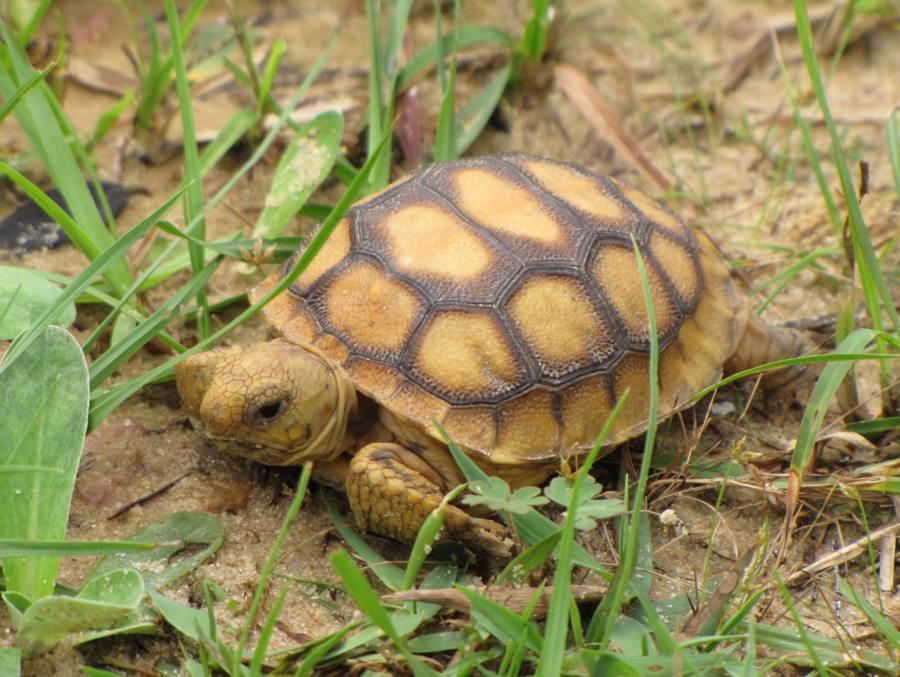
Photo: U.S. Fish & Wildlife Service (public domain)
If you own, build on, or sell land in Southwest Florida, the gopher tortoise is the one protected species most likely to touch your project. This guide explains the law in plain English: what protects the tortoise, what you legally can and can't do, what a violation costs, and how to stay compliant without wrecking your schedule.
The gopher tortoise's legal status
The gopher tortoise (Gopherus polyphemus) is listed as a Threatened species in Florida. It is protected by the Florida Fish and Wildlife Conservation Commission (FWC) under Rule 68A-27, Florida Administrative Code. Both the tortoise and its burrow are protected - a distinction that trips up more landowners than any other part of the law.
Florida has protected the gopher tortoise since 2007, when the state ended the old "incidental take" permits that had allowed developers to entomb tortoises under construction. Today the only legal path is to relocate them.
What "take" means - and why the burrow matters as much as the tortoise
FWC prohibits "take," defined broadly as to harass, harm, pursue, hunt, capture, or kill a tortoise - and specifically to molest, damage, or destroy a gopher tortoise burrow. Read that again: you can violate the law without ever seeing a tortoise, simply by collapsing an empty-looking burrow with an excavator.
Common ways people commit take without realizing it:
- Clearing or grading a lot before surveying for burrows
- "Just filling in" a hole in the yard before building
- Driving heavy equipment over a burrow within the buffer zone
- Moving a tortoise "to the woods" to be helpful
The 25-foot rule
FWC treats the area within 25 feet of any burrow entrance as a no-disturbance zone. This single number governs most residential decisions:
| Situation | What the law requires |
|---|---|
| All work stays 25+ feet from every burrow | No relocation permit needed - build around the burrows |
| Any construction, equipment, or material within 25 feet of a burrow | FWC relocation permit required before that work begins |
"Work" includes the obvious (digging, the structure itself) and the easily forgotten (equipment access paths, material and spoil stockpiles, grade changes).
The permits that make disturbance legal
When you can't honor the 25-foot buffer, an FWC permit plus authorized relocation is the way through. There are three main types:
| Permit | When it applies |
|---|---|
| 10 or Fewer Burrows | Ten or fewer burrows conflict with the project - most homes and small commercial sites |
| Conservation Permit | More than ten burrows - subdivisions, larger developments |
| Disturbed Site Permit | Burrows already disturbed without authorization - the compliance-recovery path |
Every permit starts with a survey (valid 90 days) and is carried out by an FWC Authorized Agent. Full detail: FWC gopher tortoise permitting explained.
What a violation actually costs
Illegal take of a gopher tortoise is a violation of state wildlife rules and can bring fines and a stop-work order. But for most builders the citation isn't the expensive part - the lost time is. A halted clearing operation, a reassigned crew, and an after-the-fact Disturbed Site permit can cost weeks and far exceed the $2,030 a compliant survey-and-relocation would have run. Doing it right is cheaper than getting caught doing it wrong, every time.
Who is allowed to move a tortoise
Only an FWC Authorized Agent (or, in limited 10-or-fewer situations, a property owner who has completed FWC's e-learning) may capture and relocate a gopher tortoise - and only under a valid permit. There is no "I found it, I'll move it" exception. Even well-intentioned DIY relocation is illegal and usually fatal to the tortoise, which will try to walk back to its home range.
Staying compliant without wrecking your schedule
The whole game is sequence. Survey early - ideally when you order your soil test or plans. If the report is clean, you're done. If burrows are found, the FWC permit review (2–6 weeks) runs in parallel with your building-permit review, and the relocation itself takes a day. Handled this way, gopher tortoise compliance adds zero days to your project. Discovered at clearing, it adds all of them.