- Three permit types: 10 or Fewer Burrows, Conservation, and Disturbed Site.
- The FWC permit fee is $280, a flat agency charge on top of our $1,400 relocation service fee.
- On-site relocation is free of recipient fees; off-site (canal/no-habitat) adds $5,000/tortoise.
- FWC review is typically 2–6 weeks; total survey-to-cleared is 3–7 weeks.
- A current (≤90 day) survey is required before any application.
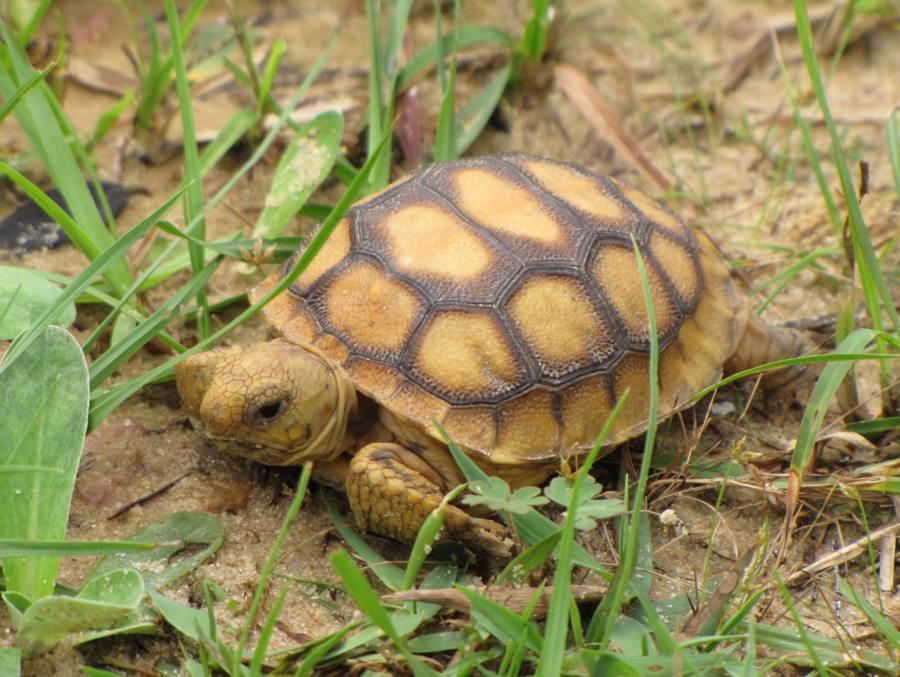
Photo: U.S. Fish & Wildlife Service (public domain)
Once a survey shows burrows that conflict with your project, an FWC permit is the legal mechanism to relocate them. This guide walks the three permit types, the process, the timeline, and the costs.
When a permit is required
A relocation permit is required whenever construction, clearing, or ground disturbance can't stay 25 feet clear of a gopher tortoise burrow. If your site plan keeps everything outside that buffer, you can build around the burrows with no permit. If not, you need one before the work begins.
The three permit types
10 or Fewer Burrows
The workhorse permit for homes and small commercial sites, used when ten or fewer burrows conflict with the project. Tortoises may be relocated on-site (if the parcel keeps at least 750 sq ft of suitable habitat, 10+ feet wide, 25 feet from construction) or off-site to a recipient conservation site.
Conservation Permit
For sites with more than ten conflicting burrows - subdivisions and larger developments. Broader in scope; relocation is typically to a permitted recipient site, and mitigation requirements scale with the project.
Disturbed Site Permit
The recovery path for sites where burrows were disturbed before getting authorization. It exists to bring a non-compliant project back into legal standing - and the sooner an authorized agent is engaged, the better the outcome.
The application process
- Survey. A current (≤90 day) FWC-format survey establishes burrow locations, counts, and classifications.
- Application. We prepare and submit the permit with the survey data, a site plan showing the conflict, and a relocation plan (on-site or recipient site).
- Review. FWC reviews - typically 2–6 weeks. We follow up so it doesn't stall.
- Relocation. On approval, authorized agents capture and relocate the tortoises; you receive compliance documentation.
On-site vs. off-site relocation
| On-site | Off-site | |
|---|---|---|
| Where the tortoise goes | Protected area of the same property | Permitted recipient conservation site |
| Required when | Parcel has qualifying habitat | No on-site habitat, or lot borders a canal/waterway |
| Extra cost | None beyond the service fee | $5,000 per tortoise to the recipient site |
The canal/waterfront rule surprises many buyers: FWC does not allow on-site relocation next to a canal or waterway, so those tortoises always go off-site.
Active, inactive and abandoned burrows
Every burrow on a survey gets one of three FWC classifications, and the classification decides whether it counts toward your permit:
| Classification | What it means |
|---|---|
| Active | Clear signs of recent tortoise use: fresh tracks, a swept apron, plastron drag marks, or a tortoise seen at the entrance. |
| Inactive | Still a usable burrow with its shape intact, but no fresh sign. Leaf litter or light debris at the mouth, no recent tracks. |
| Abandoned | Collapsed, caved in, or overgrown to the point a tortoise could not use it. No longer a functional burrow. |
The distinction that matters on a permit: FWC treats active and inactive burrows as potentially occupied, so both count toward your burrow total and both must be excavated under permit. Only genuinely abandoned burrows drop out. This is why a lot that "looks empty" can still carry a permit obligation, and why the classification call on your survey is worth getting right the first time. Our burrow identification guide walks through the field signs.
Timeline and cost
Budget 3–7 weeks from survey to cleared site, with the FWC review being the long pole. Costs: survey $350/quarter acre; relocation $1,400 (up to 2 tortoises) +$400 each additional; FWC permit fee $280 flat; off-site +$5,000/tortoise. See pricing for worked examples.
What an FWC Authorized Agent is
An FWC Authorized Gopher Tortoise Agent is a person FWC has individually authorized to capture and relocate gopher tortoises under a permit. It is a credential held by a named individual, not a company: FWC issues it after the applicant demonstrates the required field experience with the species and passes FWC's authorized agent examination, and the agent has to stay in good standing by reporting relocations accurately.
What this means for you as a landowner:
- No one else may legally handle the tortoise, however well intentioned. Not a contractor, not a landscaper, not you.
- The agent's authorization number goes on the permit, so the person doing the work is on the record.
- You can verify any agent before you hire them by asking for their FWC authorization number and confirming it with FWC.
Mr. Tortoise LLC works as an FWC Authorized Agent across Charlotte, Sarasota, Lee and DeSoto counties. Ask us for our number and check it, the same as you would a contractor's license.
Should you file it yourself?
You can, and FWC's system allows owner applications. But the paperwork needs a compliant survey, accurate burrow data, and a defensible relocation plan; errors mean resubmission and lost weeks. For the same reason people don't self-file complex insurance claims, most owners have an authorized agent handle it end-to-end.