- Base: $1,400 for up to 2 tortoises, +$400 each additional, after a $350 survey.
- FWC permit fee: $280, a flat agency pass-through cost on every relocation.
- Canal/waterfront lots force off-site relocation: +$5,000 per tortoise to the recipient site.
- A normal lot with tortoises totals ~$2,030; a canal lot with one tortoise, ~$7,030.
- Surveying before you buy turns those numbers into negotiating leverage.
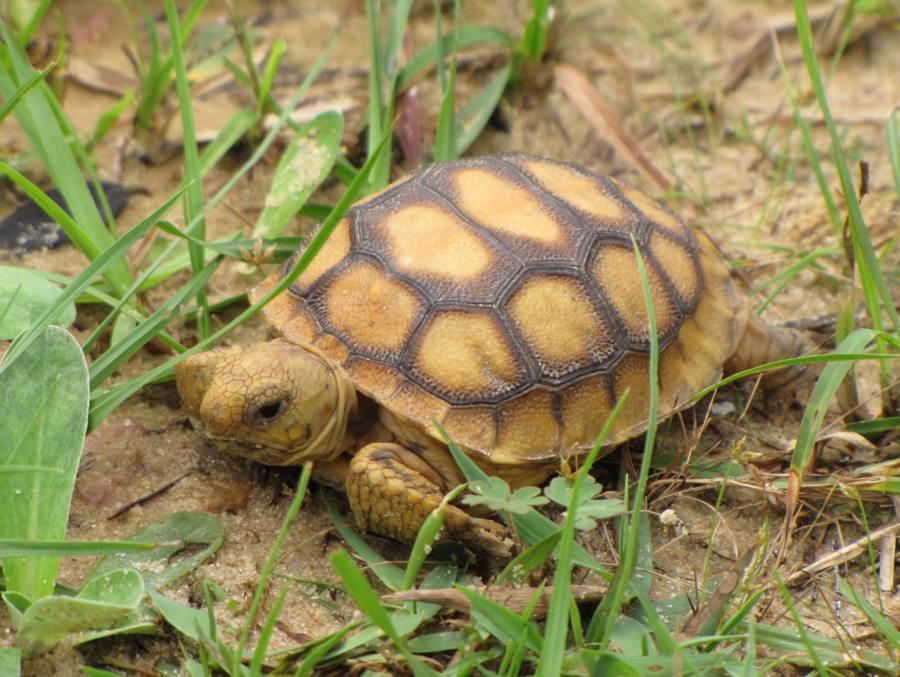
Photo: U.S. Fish & Wildlife Service (public domain)
"How much does it cost to move a gopher tortoise?" has a clean base answer and a few variables that can multiply it. Here's the whole picture, with worked examples.
The base numbers
| Item | Cost |
|---|---|
| Survey (required first, valid 90 days) | $350 per quarter acre |
| Relocation - up to 2 tortoises (we file the FWC permit application) | $1,400 |
| Each additional tortoise beyond 2 | +$400 |
| FWC permit fee (agency pass-through) | $280 |
| Off-site recipient site fee (canal/waterfront or no on-site habitat) | $5,000 per tortoise |
What drives the price up
- Tortoise count. The first two are covered by the $1,400 job fee; each additional is $400.
- Lot type. This is the big one. A canal or waterfront lot forces off-site relocation, adding $5,000 per tortoise paid to the recipient conservation site.
- Habitat availability. No suitable on-site habitat also forces off-site relocation, even away from water.
- Parcel size. Bigger parcels cost more to survey but more often qualify for (cheaper) on-site relocation.
Worked examples (standard quarter-acre lot)
| Scenario | Survey | Relocation | Permit fee | Recipient fee | Total |
|---|---|---|---|---|---|
| 1–2 tortoises, on-site | $350 | $1,400 | $280 | - | $2,030 |
| 3 tortoises, on-site | $350 | $1,800 | $280 | - | $2,430 |
| 1 tortoise, canal lot (off-site) | $350 | $1,400 | $280 | $5,000 | $7,030 |
| 2 tortoises, canal lot (off-site) | $350 | $1,400 | $280 | $10,000 | $12,030 |
The $280 FWC permit fee is a flat agency charge on every relocation, included above. Recipient fees are paid to the conservation site, not to Mr. Tortoise.
How to keep the cost down
- Survey before you buy. A burrow count and cost scenario is negotiating leverage before closing and a sunk cost after. See pre-purchase surveys.
- Build around burrows when you can. If your plan keeps everything 25+ feet clear, you skip relocation entirely.
- Prefer on-site relocation. On larger lots the tortoise can stay on your property - no $5,000 recipient fee.
- Know your lot type early. If you're eyeing canal-front, price the off-site reality in from day one.
Who pays, and when
The landowner or developer pays. On a purchase, it's negotiable between buyer and seller - which is exactly why the pre-purchase survey exists. Payment is typically due as the survey is completed and again at relocation; recipient-site fees are paid to that site per its terms. Full price table and examples: pricing page.
Cost by project type
The base numbers above don't change - what changes is how they get applied across a project:
- Single-lot homeowners (pool, lanai, shed, septic, fence) usually see the simplest math: one survey, one relocation job, done. See homeowner projects.
- Builders and developers clearing multiple lots get batch survey pricing and can schedule relocation to run parallel with the FWC permit review instead of after it, which is where most of the real time savings come from on a subdivision or multi-lot build. See builder & developer pricing.
- Buyers and realtors doing due diligence before closing use the survey alone (no relocation cost yet) to get a documented burrow count and worst-case cost scenario while it's still negotiable. See pre-purchase surveys.
Common cost mistakes
- Assuming "relocation" and "removal" are different services. They're not - people search both terms, but there's one legal process and one price.
- Skipping the survey to save $350. Without a survey there's no burrow count, no permit application, and no accurate quote - you can't legally clear the site either way, so skipping it only delays the real number.
- Not checking canal/waterfront status early. The $5,000-per-tortoise off-site fee is the single biggest cost swing on this page. Knowing your lot type before you budget avoids a mid-project surprise.
- Trying to "save money" with an unpermitted DIY move. Beyond the legal risk (see our Florida gopher tortoise laws guide), an unpermitted move usually kills the tortoise, which defeats the point.